
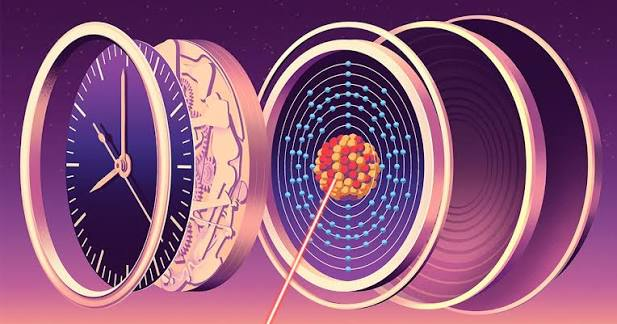
Scientists Take Major Step Towards Nuclear Clocks That Could Transform Precision Timekeeping
The world's most accurate clocks already measure time with extraordinary precision.
Scientists are now working on something potentially even more powerful.
A study published in Nature has demonstrated continuous-wave laser absorption spectroscopy of the unusual thorium-229 nucleus inside a crystal, providing a possible route towards a new generation of highly stable optical nuclear clocks.
The technology is still experimental.
But if researchers can turn the underlying physics into practical clocks, the consequences could extend far beyond knowing the time.
Ultra-precise clocks can help scientists test fundamental physics, improve measurement standards and potentially detect extremely subtle changes in the physical world.
Today's Best Clocks Already Go Far Beyond Seconds
A clock seems simple.
Something oscillates at a regular frequency, and the number of oscillations is counted.
A pendulum can do this.
So can a quartz crystal.
Modern atomic clocks use something far more precise: transitions associated with atoms.
Because atoms of the same element obey the same quantum rules, they provide extremely consistent frequency references.
This is why atomic clocks underpin much of modern precision timekeeping.
Nuclear Clocks Take the Idea Deeper
An atomic clock generally uses transitions involving electrons surrounding an atomic nucleus.
A nuclear clock would instead use an energy transition inside the nucleus itself.
That difference is important.
The nucleus is tiny compared with the overall atom and can be less sensitive to some external disturbances that affect electrons.
Researchers therefore hope a suitable nuclear transition could provide an exceptionally stable reference.
Thorium-229 Is Special
Most nuclear energy transitions require extremely energetic radiation.
That makes them difficult to manipulate with the kinds of precision lasers used in optical clocks.
Thorium-229 is unusual.
It has an exceptionally low-energy nuclear excited state.
That makes the transition accessible to laser spectroscopy and has turned thorium-229 into one of the leading candidates for nuclear-clock research.
The new Nature paper reports absorption spectroscopy of thorium-229 nuclear excited states in a thorium-doped calcium fluoride crystal.
Putting the Nuclei Inside a Crystal Could Matter
There are different ways researchers can approach nuclear-clock development.
One is to work with carefully controlled individual ions.
Another is to place large numbers of thorium nuclei inside a solid material.
The latter approach could eventually offer practical advantages.
A crystal can contain an enormous number of nuclei.
More particles potentially provide a stronger signal.
And solid-state systems could eventually be more compact and robust than laboratory setups requiring elaborate trapping equipment.
The Nature study describes its spectroscopy technique as a path towards a more efficient way of constructing a stable and robust solid-state optical nuclear clock.
The Laser Has to Find an Extraordinary Target
Spectroscopy works by examining how matter interacts with electromagnetic radiation.
Researchers tune light to particular frequencies and observe how atoms or nuclei respond.
When the frequency matches an allowed transition, energy can be absorbed.
The challenge with thorium-229 is doing this with extraordinary precision.
Researchers need to interact reliably with the nuclear transition while understanding how the surrounding crystal affects it.
That is why direct, controlled spectroscopy is an important technological step.
Why Do We Need Better Clocks?
Most people do not need a nuclear clock to arrive at work on time.
But civilisation already depends heavily on precision timing.
Telecommunications networks need synchronisation.
Navigation systems depend on accurate clocks.
Scientific facilities coordinate measurements over enormous distances.
Financial networks timestamp transactions.
And fundamental physics experiments often rely on comparing extraordinarily stable frequencies.
Improving clocks can therefore improve much more than clocks themselves.
Better Clocks Can Become Better Sensors
An ultra-precise clock does not only measure time.
It can measure its environment.
Einstein's general theory of relativity tells us that gravity affects the passage of time.
A clock at a different gravitational potential can tick at a slightly different rate.
With sufficiently sensitive clocks, those differences become measurable.
That means precision clocks can potentially function as sensors of gravitational changes.
Future systems could contribute to geodesy — the science of measuring Earth's shape and gravitational field.
They Could Help Test Fundamental Physics
Nuclear clocks are particularly interesting to physicists because they could offer new ways to test whether fundamental constants are truly constant.
Physics describes nature using quantities whose values are assumed to remain stable.
Extremely precise frequency comparisons can search for tiny deviations.
If different types of clocks drifted relative to one another in an unexplained way, scientists would want to know why.
Such measurements could potentially probe physics beyond current theories.
That does not mean nuclear clocks are expected to discover new physics automatically.
They would provide a new precision instrument with which to look.
Timekeeping Has Always Advanced Science
Better clocks have repeatedly changed what humans can measure.
Marine chronometers helped sailors determine longitude.
Atomic clocks transformed navigation and telecommunications.
Optical clocks have pushed precision measurement even further.
Each improvement opens scientific possibilities that were previously inaccessible because the measurement tools were not sensitive enough.
Nuclear clocks could represent another step in that history.
Solid-State Technology Could Make a Difference
Laboratory precision is one thing.
Building technology that can eventually operate reliably outside specialised laboratories is another.
A solid-state clock architecture is attractive partly because crystals are familiar engineering platforms.
They can be compact.
They can contain large numbers of target nuclei.
They may ultimately lend themselves to robust devices.
But solid materials also create complications.
The crystal environment interacts with the thorium nuclei.
Researchers need to understand those interactions well enough that they do not undermine the precision the clock is supposed to provide.
This Is Not Yet a Consumer Device
The phrase "nuclear clock" can make the development sound like a finished technology.
It is not.
The new research demonstrates an important spectroscopy method and a path towards a clock architecture.
Significant scientific and engineering work remains before nuclear clocks become mature practical instruments.
Researchers need reliable lasers, suitable materials, accurate frequency control and ways to understand systematic effects that could distort measurements.
The difference between demonstrating a physical principle and operating a world-leading clock is substantial.
Nuclear Does Not Mean Radioactive Power Station
The terminology can also be misleading.
A nuclear clock is not a tiny nuclear reactor.
It does not generate electricity through nuclear fission.
The word refers to the fact that the frequency reference comes from an energy transition involving the atomic nucleus.
The basic goal remains similar to other precision clocks: find an extraordinarily reliable natural frequency and measure it.
The Race for Better Clocks Is Global
Precision measurement is an international scientific field.
Researchers around the world are developing optical clocks based on different atoms and ions while also pursuing thorium-229 nuclear-clock technologies.
Competition is useful because different approaches have different advantages.
One architecture may achieve the highest accuracy.
Another may be easier to transport.
Another could be more robust.
Future timekeeping systems may therefore involve several complementary technologies rather than one universal design.
Even Existing Optical Clocks Are Extraordinary
Modern optical atomic clocks have become so sensitive that researchers can detect relativistic time differences caused by remarkably small changes in height.
That gives an idea of the scale involved.
The frontier of clock research is no longer about whether a device gains a second during a month.
Scientists are working at precision levels where effects that are invisible in everyday life become measurable.
Nuclear clocks aim to push this frontier further.
Precision Time Could Improve Navigation
Satellite navigation depends critically on timing.
A receiver determines position partly by comparing the arrival times of signals transmitted by satellites.
Tiny timing errors can translate into positioning errors.
Better clocks can therefore contribute to more accurate navigation systems.
Nuclear clocks are not about to replace existing satellite clocks tomorrow.
But long-term improvements in frequency standards can influence future navigation technology.
Telecommunications Could Benefit Too
Modern digital communications require synchronisation across networks.
As data volumes grow and networks become more sophisticated, timing standards become increasingly important.
Ultra-stable clocks can provide better references for synchronising infrastructure.
Again, this does not mean every mobile tower will contain a thorium nuclear clock.
Advanced clocks can serve as standards against which other systems are calibrated.
Science Often Advances Through Measurement
Some discoveries come from new theories.
Others come because scientists build an instrument capable of seeing something that nobody could measure before.
Telescopes revealed distant galaxies.
Microscopes exposed the cellular world.
Particle accelerators opened access to subatomic physics.
Ultra-precise clocks belong to that tradition of measurement technology.
Their scientific value comes partly from allowing researchers to ask questions that previously could not be tested with sufficient precision.
Thorium-229 Has Taken Years to Understand
Interest in the isotope is not new.
Researchers have pursued its unusual nuclear state for decades.
Progress has required advances in laser technology, nuclear spectroscopy, materials science and frequency measurement.
The latest result therefore sits within a much longer scientific effort rather than appearing suddenly.
What has changed is researchers' ability to interact with the nuclear transition increasingly precisely and reproducibly.
The Crystal Could Turn Physics Into Technology
This is perhaps the most interesting part of the latest work.
Discovering an unusual nuclear transition is fundamental science.
Embedding thorium in a crystal and learning to interrogate it efficiently moves towards engineering.
That transition — from understanding a phenomenon to controlling it — is how many technologies begin.
Lasers themselves were once laboratory physics.
Today they are found in telecommunications, medicine, manufacturing and consumer electronics.
There Is Still Plenty to Prove
Researchers will need to determine how far the solid-state approach can ultimately be pushed.
Crystal environments can introduce frequency shifts and other effects.
Those effects must be characterised and controlled if a clock is to achieve extreme accuracy.
Alternative thorium clock architectures will continue developing at the same time.
It is therefore too early to declare which approach will eventually dominate.
A New Kind of Clock Is Coming Into View
What researchers have demonstrated is another significant piece of the puzzle.
The Nature study reports continuous-wave laser absorption spectroscopy of thorium-229 nuclear excited states in a doped crystal and describes the approach as a route towards more efficient, highly stable and robust solid-state nuclear clocks.
That does not mean nuclear clocks will soon appear in homes or phones.
Their first applications are much more likely to be in precision science and metrology.
But the history of measurement technology suggests that today's specialised scientific instrument can eventually influence technologies far beyond the laboratory.
The clock on the wall tells us what time it is.
The clocks scientists are now building could help tell us something deeper:
whether the laws and constants used to describe the universe behave exactly as we think they do.