A software defect was responsible for the recent air traffic control failure that caused widespread disruption across Britain and contributed to the cancellation of around 2,000 flights, UK air traffic control operator NATS has revealed.
The technical failure affected Britain's flight data processing system and dramatically reduced the number of aircraft controllers could safely handle, creating knock-on disruption at airports across the country.
NATS chief executive Martin Rolfe said the underlying problem involved a coding defect triggered by the timing of particular data requests. Although the failure reduced capacity, backup procedures operated as intended and aviation safety was not compromised, according to the company.
What Caused the UK Air Traffic Control Failure?
The problem originated in a specific part of the flight data system used by NATS.
According to the operator's explanation, an unusual timing combination involving data requests triggered a software defect. That forced the system into a degraded operating mode and reduced the volume of flights that air traffic controllers could process.
The problem was therefore not caused by a cyberattack or an airline computer system.
It was an infrastructure software failure inside the network responsible for managing UK airspace.
Around 2,000 Flights Were Cancelled
The consequences quickly spread through Britain's aviation network.
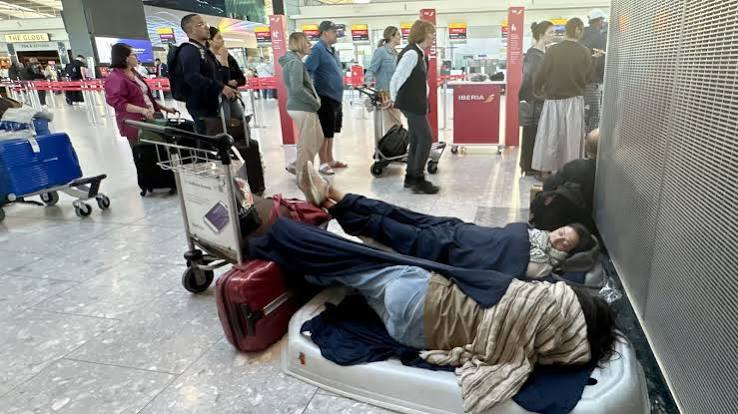
Approximately 2,000 flights were cancelled, while hundreds of thousands of passengers were affected by cancellations, delays and disruption to connecting journeys.
Major airports including Heathrow, Gatwick, Manchester and Stansted experienced restrictions during the disruption. When the technical problem initially occurred, Heathrow temporarily suspended arrivals before operations began recovering.
Even after the immediate system problem was resolved, disruption could not disappear instantly.
Aircraft and crews were no longer necessarily positioned where airlines had planned them to be. Passengers who missed connections needed alternative flights, while airport schedules had to absorb services delayed from earlier in the day.
Why One Software Error Can Affect Thousands of Flights
Modern aviation is an enormous interconnected network.
Airlines schedule aircraft, pilots and cabin crews across multiple airports throughout the day. An aircraft arriving in London in the morning may operate several additional flights before night.
When one journey is cancelled or substantially delayed, the aircraft may not be available for its next scheduled service.
The same applies to crews.
Pilots and cabin crew operate under strict working-time requirements. A long delay can therefore leave an aircraft available but without a crew legally permitted to operate the next flight.
This explains why an air traffic control problem lasting a relatively limited period can produce disruption that continues much longer.
Heathrow and Other Major Airports Were Hit
The incident affected some of Britain's busiest aviation hubs.
Heathrow, Gatwick, Manchester and Stansted were among the airports affected when air traffic restrictions were imposed. Airlines including Ryanair and Wizz Air subsequently criticised NATS over the disruption.
Heathrow is particularly important because it functions as a major international connecting hub.
Passengers do not necessarily begin or end their journey in London. Many transfer between flights, meaning disruption at Heathrow can affect itineraries extending across Europe, North America, Asia and other regions.
A failure inside Britain's aviation infrastructure can therefore become an international travel problem remarkably quickly.
NATS Says Safety Was Not Compromised
One of the most important distinctions in the investigation is between capacity and safety.
According to NATS, backup protocols functioned when the software defect occurred. The system therefore reduced the amount of traffic controllers could manage rather than allowing aircraft to continue operating normally under uncertain technical conditions.
That approach inevitably creates delays and cancellations, but restricting traffic is precisely how aviation systems are designed to respond when critical infrastructure cannot operate at normal capacity.
The operational consequences were substantial, but NATS has said flight safety itself was maintained.
Airlines Are Demanding Answers
The disruption has nevertheless generated strong criticism from airlines.
Ryanair has called for NATS chief executive Martin Rolfe to resign, while Wizz Air has called for reforms. Britain's Civil Aviation Authority has said it will consider whether further steps are necessary.
The central question is not simply why the software failed.
Regulators and airlines also want to understand why the defect was not detected earlier and whether Britain's aviation infrastructure has sufficient resilience to prevent a single technical fault from creating disruption on such a large scale.
Transport Minister Heidi Alexander described the disruption as unacceptable and has launched an independent review.
Britain Has Experienced Air Traffic Problems Before
The latest incident has inevitably revived memories of previous NATS failures.
Britain suffered major air traffic disruption in 2023 after the system encountered unusual flight-plan data that it could not process correctly. Another disruption occurred in 2025.
NATS says the latest software defect was not related to those previous incidents.
That distinction matters technically, but repeated disruption creates a broader policy question about the resilience of infrastructure on which millions of passengers and large parts of Britain's economy depend.
Aviation Is Critical Infrastructure
Air traffic control is largely invisible when it works correctly.
Passengers interact with airlines and airports, but behind those companies sits a complex infrastructure network coordinating aircraft through controlled airspace.
A failure in that network can have economic consequences extending well beyond frustrated travellers.
Business trips can be cancelled. Cargo shipments can be delayed. Tourism businesses can lose customers. Airlines face compensation, accommodation and rebooking costs, while airports experience sudden scheduling problems.
That makes aviation software part of Britain's critical national infrastructure.
The Incident Highlights the Risks of Software-Dependent Infrastructure
The disruption also illustrates a much broader technological issue.
Transport, banking, healthcare, telecommunications and energy networks increasingly depend on enormous software systems operating continuously in the background.
Most people rarely notice those systems until one fails.
The challenge is that modern software can contain millions of lines of code and interact with large quantities of real-time information. An unusual combination of circumstances may expose a defect that was never triggered during ordinary testing.
For safety-critical systems, that makes redundancy particularly important.
The goal is not to assume software will never fail. It is to ensure that when failure occurs, backup systems prevent a technical problem from becoming a safety disaster.
NATS Is Working on a Permanent Fix
NATS has introduced mitigation measures while a permanent software correction undergoes further safety testing.
That testing process matters because changes to critical aviation software cannot simply be pushed live in the same way a consumer smartphone application receives an update.
Engineers need to establish that the fix resolves the original problem without introducing another vulnerability.
The independent review will meanwhile examine the incident and the wider resilience of the UK's air traffic control infrastructure.
What UK Passengers Should Watch Next
The immediate outage has ended, but the consequences of the investigation could last much longer.
Passengers will want confidence that another technical failure will not produce the same scale of disruption. Airlines want greater reliability from the air traffic control network, while regulators will be looking closely at the resilience of the underlying technology.
The investigation will therefore focus on more than one coding error.
The bigger question is how a defect inside a critical software system was able to contribute to around 2,000 cancelled flights and disruption for hundreds of thousands of people.
For Britain's aviation industry, answering that question may prove more important than simply fixing the line of code that caused the failure.