


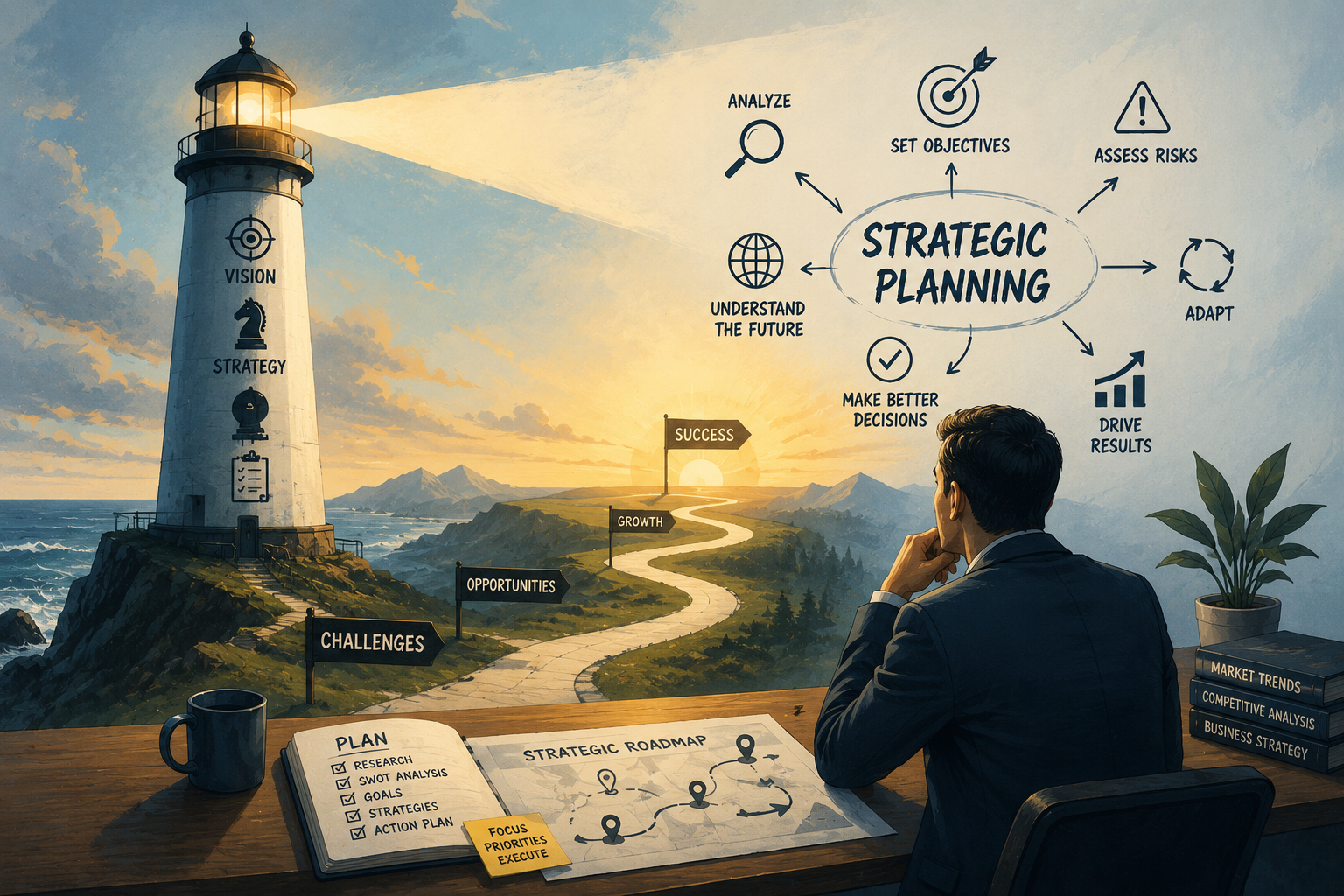
Discover why strategic planning is essential for business success, helping organisations set clear goals, manage risks, improve decision-making, and achieve sustainable growth.
Why Strategic Planning Matters More Than Ever
In an increasingly competitive and fast-changing business environment, organisations can no longer rely on short-term decisions alone. Economic uncertainty, technological advancements, changing customer expectations, and global competition require businesses to think beyond daily operations. This is why strategic planning has become more important than ever.
Strategic planning provides a clear roadmap that helps businesses define their objectives, allocate resources effectively, and prepare for future opportunities and challenges. Rather than reacting to change, organisations with a well-developed strategy can anticipate market shifts and make informed decisions that support sustainable growth.
What Is Strategic Planning?
Strategic planning is the process of setting long-term business goals and developing a structured plan to achieve them. It involves analysing the current business environment, identifying opportunities and risks, and creating actionable strategies that align with an organisation’s vision.
A strong strategic plan typically includes:
- Business goals and objectives
- Market analysis
- Competitive positioning
- Financial planning
- Resource allocation
- Risk management
- Performance measurement
- Growth strategies
This process ensures that every decision contributes to the organisation’s long-term success.
Why Strategic Planning Is Essential
Without a clear strategy, businesses often focus only on daily tasks and immediate challenges. While managing day-to-day operations is important, long-term success requires a broader perspective.
Strategic planning helps businesses:
- Establish clear priorities
- Improve decision-making
- Allocate resources efficiently
- Prepare for future growth
- Respond to market changes
- Reduce uncertainty
- Strengthen organisational focus
Businesses with defined strategies are generally better equipped to adapt and remain competitive.
Setting Clear Business Goals
One of the primary benefits of strategic planning is the ability to define measurable objectives.
Clear goals provide direction for employees and leadership teams while helping organisations monitor progress.
Examples of strategic goals include:
- Increasing annual revenue
- Expanding into new markets
- Launching new products
- Improving customer satisfaction
- Enhancing operational efficiency
- Strengthening brand recognition
Well-defined objectives create accountability throughout the organisation.
Improving Decision-Making
Business leaders make important decisions every day. Without a strategic framework, these decisions may become reactive rather than purposeful.
Strategic planning supports better decision-making by encouraging leaders to consider:
- Long-term business objectives
- Financial implications
- Market opportunities
- Customer expectations
- Organisational capabilities
- Potential risks
A structured decision-making process improves consistency and reduces uncertainty.
Managing Business Risks
Every organisation faces risks, including economic fluctuations, supply chain disruptions, technological changes, and competitive pressures.
Strategic planning helps businesses identify potential risks before they become major problems.
Effective risk management includes:
- Market analysis
- Financial forecasting
- Scenario planning
- Business continuity planning
- Regulatory compliance
- Diversification strategies
Preparing for uncertainty improves organisational resilience.
Adapting to Market Changes
Markets evolve continuously due to technological innovation, changing consumer preferences, and global economic developments.
Businesses that review and update their strategies regularly can respond more effectively to these changes.
Adaptability may involve:
- Introducing new products
- Updating pricing strategies
- Investing in technology
- Expanding digital services
- Entering emerging markets
Strategic planning encourages organisations to remain flexible while maintaining long-term objectives.
Aligning Teams Around a Shared Vision
A successful strategy is understood and supported by the entire organisation.
Strategic planning helps employees understand:
- Company objectives
- Individual responsibilities
- Performance expectations
- Organisational priorities
When everyone works towards the same goals, collaboration improves and productivity increases.
Supporting Financial Stability
Financial planning is an essential component of every business strategy.
Strategic planning enables organisations to:
- Prepare realistic budgets
- Forecast revenue
- Control operating costs
- Prioritise investments
- Manage cash flow
- Allocate resources effectively
Sound financial planning supports sustainable business growth while reducing unnecessary financial risks.
Encouraging Innovation
Innovation is an important driver of long-term business success.
Strategic planning creates opportunities to:
- Invest in research and development
- Adopt new technologies
- Improve customer experiences
- Streamline business processes
- Explore new business models
Organisations that include innovation within their strategic plans are better positioned to remain competitive.
Measuring Business Performance
A strategy should include measurable performance indicators that allow businesses to evaluate progress.
Common metrics include:
- Revenue growth
- Profit margins
- Customer retention
- Employee productivity
- Market share
- Customer satisfaction
- Return on investment
Regular performance reviews help organisations identify strengths, address weaknesses, and refine their strategies.
Common Challenges Without Strategic Planning
Businesses that operate without a clear strategy often experience:
- Unclear priorities
- Inefficient resource allocation
- Slow decision-making
- Inconsistent business performance
- Difficulty adapting to change
- Missed growth opportunities
A lack of direction can make it difficult for businesses to achieve sustainable long-term success.
Best Practices for Effective Strategic Planning
Successful organisations regularly review and improve their strategic planning processes.
Best practices include:
- Conducting market research
- Involving key stakeholders
- Setting realistic objectives
- Monitoring industry trends
- Reviewing progress regularly
- Remaining flexible when circumstances change
- Communicating goals clearly across the organisation
A strategy should evolve as the business environment changes rather than remaining static.
Preparing for the Future
Business environments are becoming increasingly dynamic, making long-term planning more valuable than ever.
Future-focused organisations invest in:
- Digital transformation
- Workforce development
- Customer experience improvements
- Sustainable business practices
- Data-driven decision-making
- Innovation initiatives
Strategic planning helps businesses prepare for emerging opportunities while remaining resilient during periods of uncertainty.
Conclusion
Strategic planning provides businesses with the structure and direction needed to achieve sustainable long-term success. By setting clear objectives, improving decision-making, managing risks, and aligning resources with organisational goals, companies can confidently navigate changing market conditions and remain competitive.
Rather than simply responding to challenges as they arise, businesses with strong strategic planning anticipate change, seize new opportunities, and continuously improve their operations. Investing time in developing and maintaining an effective strategy is one of the most valuable decisions any organisation can make for its future growth and success.
