


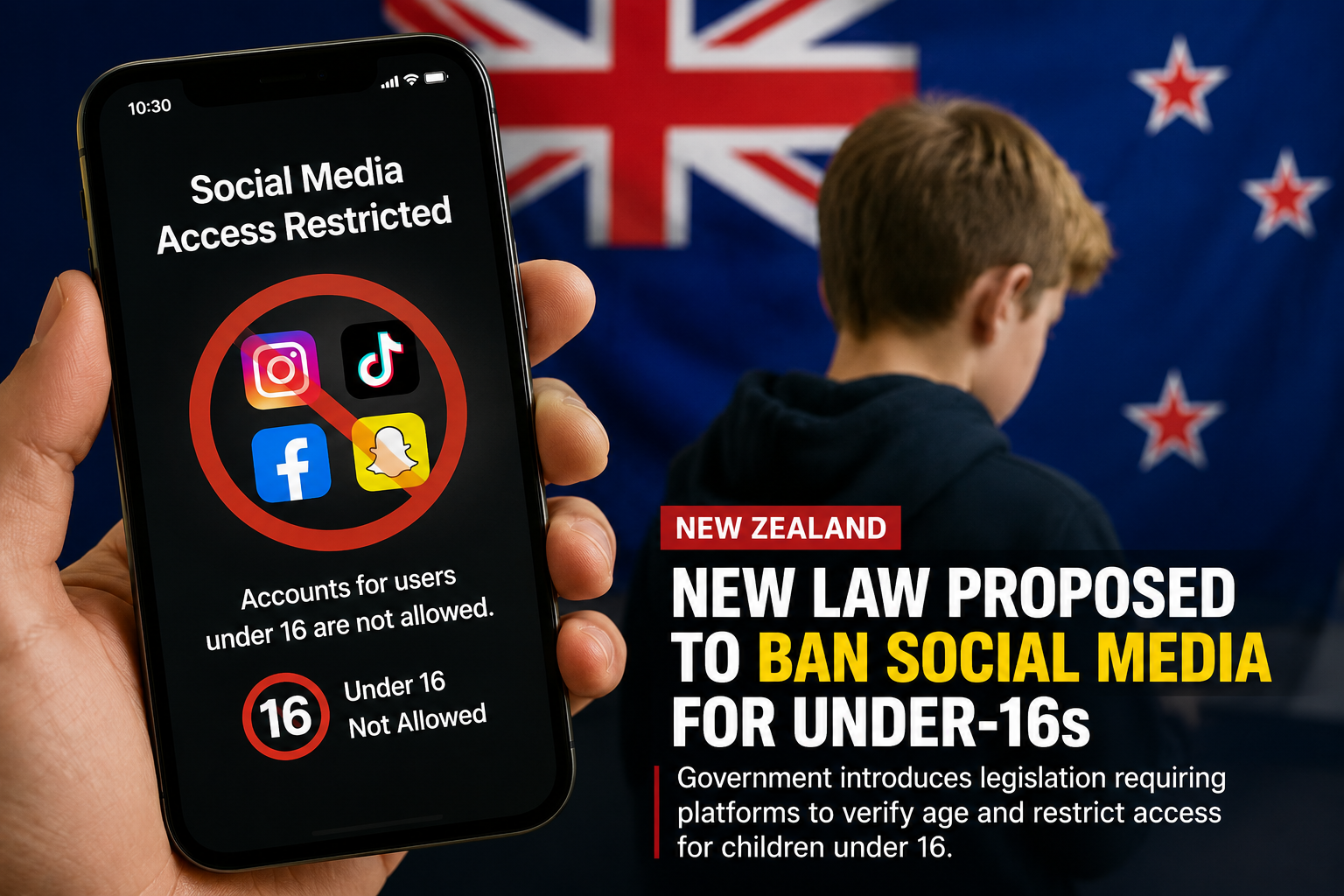
New Zealand is moving toward one of its most significant changes to online safety regulation, with the government preparing legislation aimed at preventing children under the age of 16 from using major social media platforms.
The proposal places New Zealand at the centre of a rapidly expanding international debate over how governments should respond to the influence of social media on children and teenagers.
Under the proposed framework, social media companies would be expected to take reasonable measures to determine whether users meet the required minimum age.
The legislation could also introduce major financial consequences for companies that fail to comply with the rules.
The development comes as governments around the world increasingly question whether existing age restrictions used by technology platforms provide enough protection for younger users.
Why New Zealand Is Considering the Restriction
Social media has become deeply integrated into the everyday lives of young people.
Platforms allow teenagers to communicate with friends, discover entertainment, follow creators and participate in online communities. However, concerns have continued to grow over the potential consequences of excessive or inappropriate social media use.
Policymakers, parents and child-safety organisations have raised questions about cyberbullying, harmful content, privacy, addictive design features and the amount of time children spend online.
New Zealand’s proposed legislation represents an attempt to shift more responsibility toward the companies operating these platforms.
Instead of relying primarily on young users to accurately declare their ages, platforms could be required to introduce stronger methods for determining whether someone is eligible to hold an account.
Age Verification Could Become a Major Issue
One of the most important questions surrounding the proposed law is how age verification would work in practice.
According to current reporting, platforms could potentially use several methods to determine a user’s age, including existing account information, digital identity systems and facial age-estimation technology.
That creates another complicated debate.
Protecting children online requires platforms to know whether a user is a child. But collecting additional information to determine someone’s age can create privacy concerns of its own.
Technology companies and regulators may therefore have to find a balance between reliable age checks and protecting personal information.
A system that is too weak could be easily bypassed.
A system that requires excessive personal information could face criticism from privacy advocates.
Finding the right approach may ultimately become one of the biggest challenges in implementing the legislation.
Technology Companies Could Face Significant Penalties
The proposal is not simply an advisory recommendation.
Companies that fail to follow the requirements could face substantial financial penalties.
Current reports indicate that fines could reach as much as 10 percent of a platform’s global revenue in serious cases of non-compliance.
Such a penalty structure would significantly increase the importance of compliance for major international technology companies.
For the world’s largest social networks, global revenue can reach billions of dollars. A penalty calculated as a percentage of worldwide revenue could therefore become financially significant.
The approach also reflects a wider change in how governments regulate technology companies.
For years, social media companies largely determined their own rules surrounding account access, content moderation and user safety.
Governments are now increasingly introducing legislation that places legal obligations directly on platforms.
A Wider Global Debate
New Zealand is not considering online age restrictions in isolation.
The question of children’s access to social media has become an international policy issue.
Australia has already moved toward stronger restrictions for younger social media users, while governments and regulators in other countries are examining their own approaches to online child safety.
The broader debate reflects a major change in attitudes toward social media.
When platforms first became popular, much of the discussion focused on connectivity, communication and technological innovation.
Today, policymakers are paying much closer attention to how algorithms, advertising systems, recommendation engines and constant digital engagement may affect younger users.
The issue has become particularly important as smartphones have made social media accessible throughout almost every part of the day.
Supporters See Greater Protection for Children
Supporters of stricter age restrictions argue that childhood should not be shaped entirely by algorithms designed to maximise engagement.
They believe delaying access to social media could reduce children’s exposure to cyberbullying, inappropriate material, online manipulation and potentially harmful digital habits.
Another concern involves recommendation algorithms.
Modern platforms do not simply display content selected by users. Their systems constantly recommend new videos, posts and accounts based on previous activity.
This can make social media highly engaging, but critics argue that younger users may be particularly vulnerable to spending excessive amounts of time consuming algorithmically recommended content.
Supporters of regulation therefore believe governments have a legitimate role in establishing stronger protections.
Critics Raise Questions About Privacy and Enforcement
The proposal is also likely to face criticism.
One major concern involves enforcement.
Young people who are comfortable with technology may find ways to bypass age restrictions, particularly if verification systems rely on information that can be easily changed.
Another issue is privacy.
If platforms must verify the age of millions of users, they may need to process additional personal information.
Critics could argue that protecting children’s privacy should not require creating systems that collect even more sensitive information from internet users.
There are also questions about whether banning access addresses the underlying problems associated with social media.
Some experts favour stronger digital education, parental controls, safer platform design and improved content moderation rather than broad age restrictions.
The debate is therefore likely to focus not only on whether children should have social media accounts, but also on what responsibilities technology companies, parents, schools and governments should each carry.
Social Media Platforms Face a Changing Regulatory World
Whatever happens with New Zealand’s legislation, the direction of global technology regulation is becoming increasingly clear.
Governments are becoming less willing to allow major platforms to regulate themselves without significant external oversight.
Issues including children’s safety, artificial intelligence, data privacy, misinformation and algorithmic transparency are attracting new legislation around the world.
For social media companies, this could mean operating under different requirements depending on the country.
Technology companies may eventually decide that implementing stronger age-verification systems globally is easier than maintaining completely different systems for individual markets.
If that happens, laws introduced in relatively small countries could ultimately influence how social platforms operate internationally.
What Happens Next?
The proposed legislation will have to move through New Zealand’s parliamentary process before becoming law.
That process is likely to produce further debate over enforcement, privacy, penalties and exactly which online services should fall under the restrictions.
Technology companies, child-safety advocates, privacy organisations, parents and young people themselves are all likely to follow the debate closely.
The final rules could also become an important reference point for other countries considering similar legislation.
The central question extends well beyond New Zealand:
At what age should children be allowed to independently enter the world of algorithm-driven social media?
As governments search for an answer, New Zealand’s latest move shows that the era of largely unrestricted social media access for younger users is facing increasing political scrutiny.
What began as a discussion about parental responsibility is rapidly becoming a global debate about technology regulation, corporate responsibility and how societies should protect the next generation in an increasingly digital world.
